Google

8.01.2007

The Charts Show That Thursday's Stock Market Plunge Was Really Just A "Blip"


The Dow Jones Industrial Average lost 311.50 points Thursday. On the rankings of Top 10 Daily Losses of All-Time, 311.50 doesn't even come close, according to djindexes.com (and the charts above).

So, as we always do, let's put Thursday's action in perspective for the average person.

#7 on the "total points" list happened five months ago today -- February 27, 2007. On that day, the Dow lost 416.02.

Was it a crisis? Probably not. We know that because if you pulled your money out of the market February 27, you would have missed the 10.3% in market gains since that day.

Thursday's loss doesn't register in the Top 10 on a points basis, and on a percentage basis, it's even farther off the chart. At 2.3%, the loss is just a blip.

The point is this: If you are invested in stocks, don't react too swiftly to the headlines. Many passive investors lose money when trying to time the market's ups-and-downs. If you're nervous about your exposure to stock market fluctuations, speak with your wealth planning professional for advice.

The Dow's worst day ever remains Black Monday on which the market lost 22.61%. Since that date, however, the Dow Jones Industrial Average has added more than 12,000 points. Investors that stayed the course endured temporary pain, but emerged as winners.

Don't let Thursday's losses get your down.

(Image courtesy: Dow Jones Indexes)

Using Flip-Charts To Understand How Sub-Prime Mortgages Work


This video from CNBC via YouTube does a terrific job of illustrating how sub-prime mortgage defaults are impacting mortgage rates overall.

There's some jargon in there, but overall, it's very easy to follow.

The Biggest Banks Are Eliminating The Most Prevalent Sub-Prime Loan

Mixed news from the sub-prime sector, depending on how you look at it. Many lenders discontinuing their short-term ARM products.

Washington Mutual, Countrywide and Wells Fargo are among the sub-prime lenders no longer offering the 2/28 mortgage product.

The "2/28" is a adjustable rate mortgage in which the interest rate remains fixed for two years, and then adjusts for the loan's remaining 28 years.

The 2/28 mortgage was the basis of all sub-prime lending in recent years.

First Franklin has gone a step further, eliminating the 2/28 and the 3/27. As you'd expect, the 3/27 is a mortgage in which the interest rate remains fixed for three years, and then adjusts for the loan's remaining 27 years.

Lenders are continuing to offer 5/25 mortgages and 30-year fixed mortgages.

The mortgage lenders hope that longer "fixed rate periods" on their mortgage products will help keep their loans from defaulting so soon.

Today, 2/28s originated in 2003 and 2004 are in their adjustment phase and are contributing to rising foreclosure rates across the country.

For homeowners, the downside to loan portfolio paring is that longer fixed-rate periods creates more "time risk" for the lending bank and, therefore, leads to higher interest rates for home loans.

The potential upside, though, is that better sub-prime loan performance overall will reduce the risk levels in sub-prime, thereby lowering mortgage rates. Either way, borrowing money classified as "sub-prime" continues to get more difficult.

If you believe you are a sub-prime borrower, speak with your mortgage lender and/or financial planner and craft a plan to improve your credit rating and lending risk profile.

(Image courtesy: The Wall Street Journal)

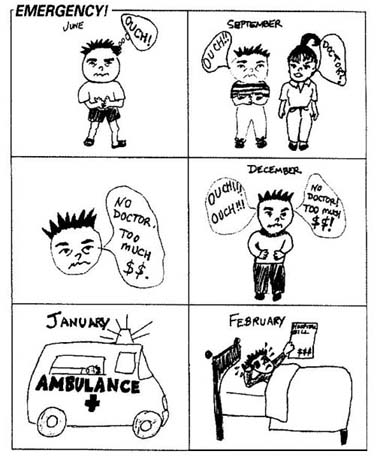
Why Medical Bills Are More Dangerous To Homeowners Than ARMs

If you own a home and somebody else depends on your income, consider that the leading cause of home foreclosures is not "adjustable rate mortgages".

As cited many times over (including by a Harvard law professor), the answer is medical bills.

Even for the insured, medical expenses can dramatically impact a family's finances and push it into bankruptcy.

Over one million families discovered that sad fact in 2004 and medical bills have not gotten any cheaper, says the Bureau of Labor Statistics.

Death is another major cause of foreclosure.

When a family's primary wage-earner dies, the secondary wage-earner is now obligated to pay the family's monthly obligations and that may include a mortgage payment. Sadly, that income may not be enough to cover the bills.

A strong life insurance policy can offset bills, ease transition periods, and even pay off the home's remaining mortgage obligation.

Whether you're a first-time buyer or a seasoned investor, consider protecting yourself and your family with adequate medical and life insurance coverage, as well as taking preventative health care steps.

There are resources online to help you determine what coverage is necessary, but the best place to start for this highly personal discussion is with your personal financial planner.

Life is a series of surprises and it's never too soon to be prepared.

(Image courtesy: NCSALL)

Back From Vacation ...

Time to get plugged back in ...

It sure has been an interesting ride in the markets the last week or so ...